Develop Cross-Platform CLI and GUI Tools With Tcl/Tk. Powerful, Event-Driven, Open-Source And Future-Proof Toolkit… From the Past?!
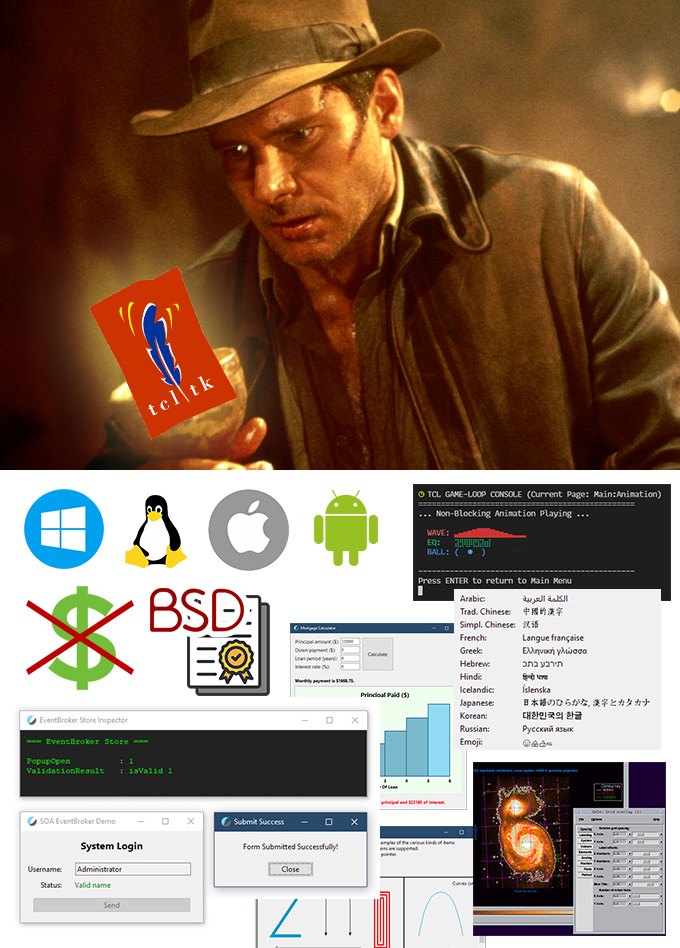
What if I told you there exists a language, or a whole toolkit that:
- Can be used to create cross-platform Console and GUI tools or apps
- Those GUI apps look native on Windows, Linux and macOS
- Supports safe and efficient threading, non-blocking events and I/O
- Has a small footprint of about 100MB with most common packages installed
- Can produce very compact single-file apps for any supported platform
- Is capable of building robust cross-platform Web Apps
- Has existed and been in use by some of the largest corporations for over three decades
- Is free and BSD-licensed, so you can do whatever you want with it, or to it
Would you believe me?
Foreword
Documenting personal experiences on fascinating or useful topics is what I do. Real-time visualization, 3D simulation, data safety, energy efficiency, or even input devices, microcontrollers, and fitness — an endless stream of ideas for new studies and exploration is always on the To-do list.
This particular topic turned out to be quite a bit more involved than I originally planned. But I promise: all information here is what I myself would've loved to have known before I started my Tcl/Tk toolkit learning journey.
I'm writing this long after my honeymoon phase with Tcl/Tk ended, and will try to be as objective and honest as possible. For your benefit, and my own. I have nothing to "sell" except my personal experience, hoping to better inform you and simplify the "onboarding" process if you ever decide to give Tcl/Tk a try.
Due to its command-centric nature, Tcl is a powerful, yet widely misunderstood language. I want to contribute to the conversation, aiming to clear up this persistent confusion with concise explanations and concrete examples. And a bit of flair, of course, to keep you entertained.
Please note: We’re skipping the "Programming 101" talk here with the assumption that you already have a baseline familiarity with general programming logic. If you know your way around an if statement and know what a function is, you're probably ready to dive straight into Tcl-specific structures and syntax. Think of this article as both a "Tcl hands-on" and a primer, hoping to make you, too, discover and appreciate this almost 40-year-old technology that quietly powers the world. And maybe convince you to try it for yourself, and spread the word.
As for the "About the Author" — if you're interested, please visit the "About" page.