Just... A handful of reps to go... C'mon…
A-a-and, there! Phew, that was an intense workout indeed!
Wait a minute... Wasn't there something I was working on? ...
Oh, right! The blog post!
One Moment, Please...

It took a while to finish this post.
I was planning to publish it exactly one year after the previous post, with the goal of showcasing what kind of progress one might expect over a similar timespan doing 2-3 Ring Fit workouts a week. As I still play the game and the numbers keep changing, let's pretend it's still March 2021 — the month I took all screenshots and videos for this post — and use them as our reference point.
6-Year Follow-Up Available!
⭐⭐⭐ Don't miss the follow-up post: 6 Years Of Fitness With Ring Fit Adventure. Results, Custom Workouts, Notes On Sustainable Wellness. And a Survey! Find out whether the game actually managed to pass the test of time — or if I ultimately lost interest, became a functional adult, and finally grew a mandatory beer belly. ⭐⭐⭐

Important September 2025 Switch 2 Update
This post was written and published long before the Switch 2 release — well before the resulting long list of controversial decisions and price changes by Nintendo. Besides, the new magnetic Joy-Cons that the Switch 2 uses won't fit the original Ring controller, so you'd also need to buy the original Switch 1 Joy-Cons to play the game. As of now, Nintendo hasn't even announced whether a Ring controller compatible with the Switch 2 Joy-Cons is in the works. Considering how hard Nintendo is working on ripping its customer base off with "enhanced" $10 updates, paid demos like the "Nintendo Switch 2 Welcome Tour," and a myriad of online features like Nintendo Online (paid, of course) — it seems like it'll be a loooong time until they decide to go back to updating the Ring controller. Switch 2 is already very expensive. Add a couple of the original Switch 1 controllers to the mix, as well as a charger for them, and it's bordering on unreasonable. Simply put — if you don't own Ring Fit Adventure and are considering picking up a copy after reading this post, just buy a used Nintendo Switch to play it on and avoid the Switch 2.
Ahem... Where Was I?
A Full Cycle Later
Well, 2020 sure was a year of... Interesting events, news and developments. As for me, it was also a year of getting back in shape thanks to a very special and exciting video game titled Ring Fit Adventure.
Join me today, as I share my experience with the game, the console, go through some personal milestones, and provide several tips and tricks along the way. Hopefully, by the end you'll be able to tell exactly how this product has improved the quality of my life and maybe consider doing the same.
Disclaimer: since it's practically mandatory these days when discussing products and services, I should clarify that this post wasn't sponsored by anyone or any company.
Let's begin by examining the hardware.
The Hardware
As you are no doubt aware, the signature aspect of Ring Fit Adventure is its proprietary Ring Controller, which makes the unique gameplay mechanics of the title possible. So here's my Ring Con after over 75 000 full presses and press & holds and 6 000 seconds of pull & holds — still good as new.
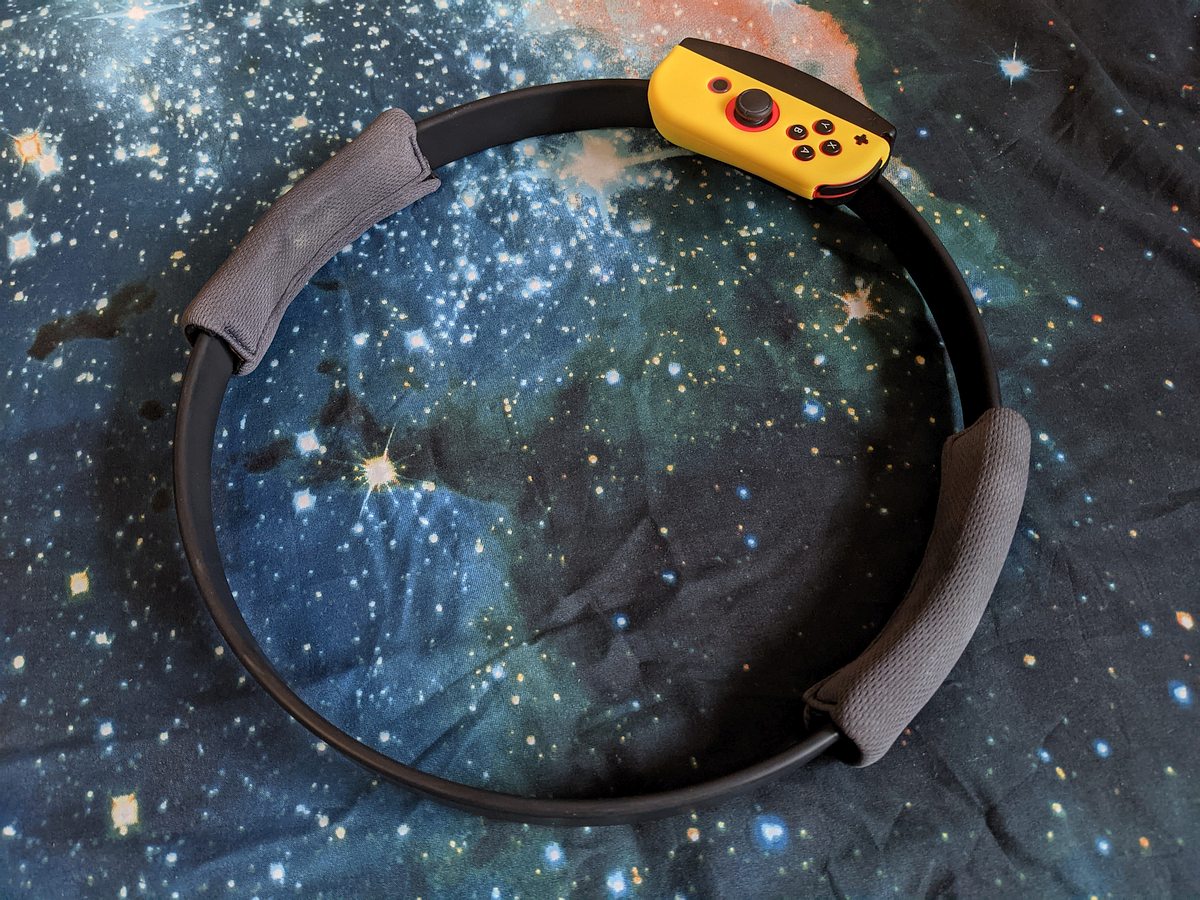
I have to give credit where it's due: Ring Con is an exceptionally well-made controller. Even after such a beating, it doesn't squeak, wobble or show any noticeable wear and tear — neither on the outside, nor in operation.
The same more or less goes for the leg strap.
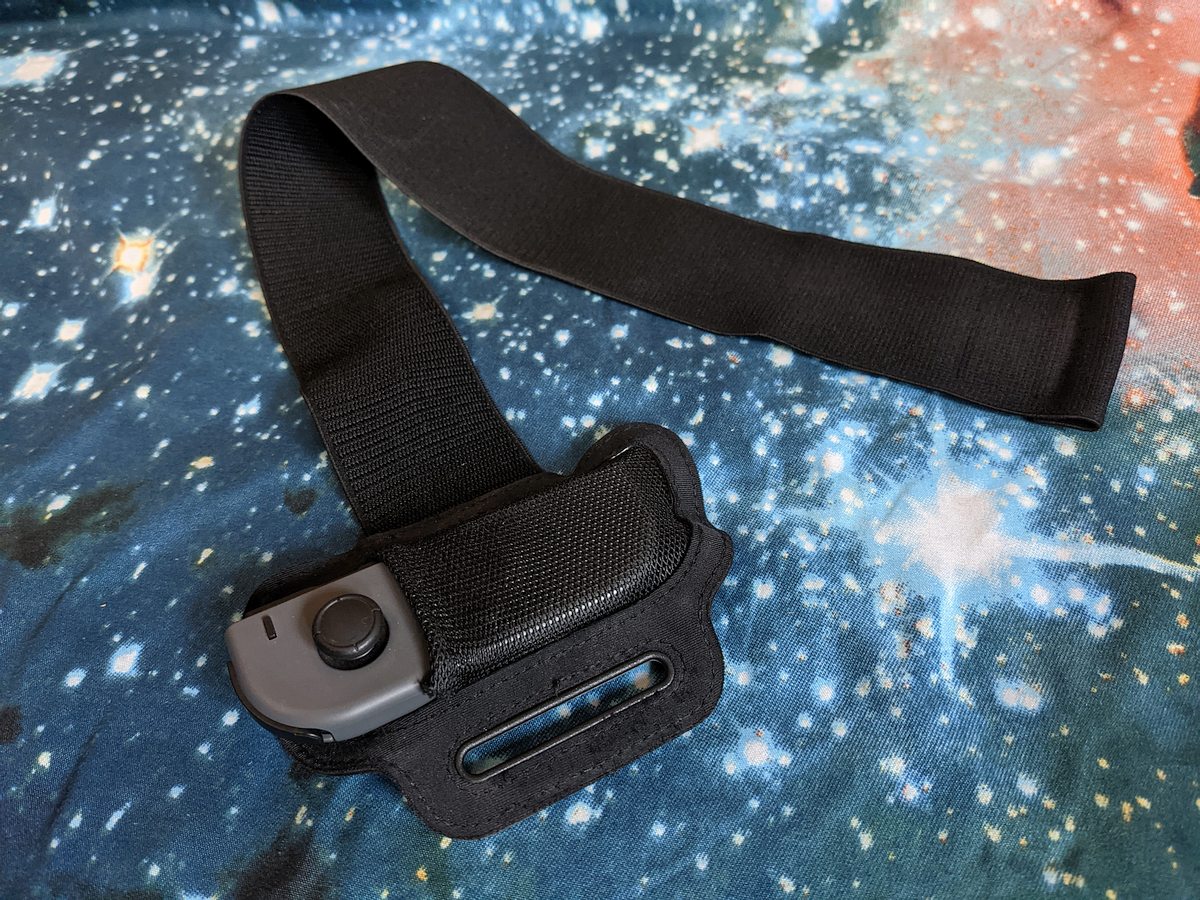
It still holds a Joy-Con tight and doesn't slide off the leg during workouts. My strap did eventually develop a small tear, probably from wearing it too tightly or from not being gentle enough when swapping the Joy-Cons in and out for charging. Either way, it holds the controller well.
The Joy-Cons themselves are also doing well, although the left unit did ultimately succumb to the notorious stick drift after about 200 hours of playtime in various other games between Ring Fit workout sessions (hey, it's a game console after all, might as well use it as one). So I had to fix the drift by replacing the analog joystick module. It's a trivial affair, as long as you can get your hands on the new part and the tools to disassemble the controller. No soldering required.
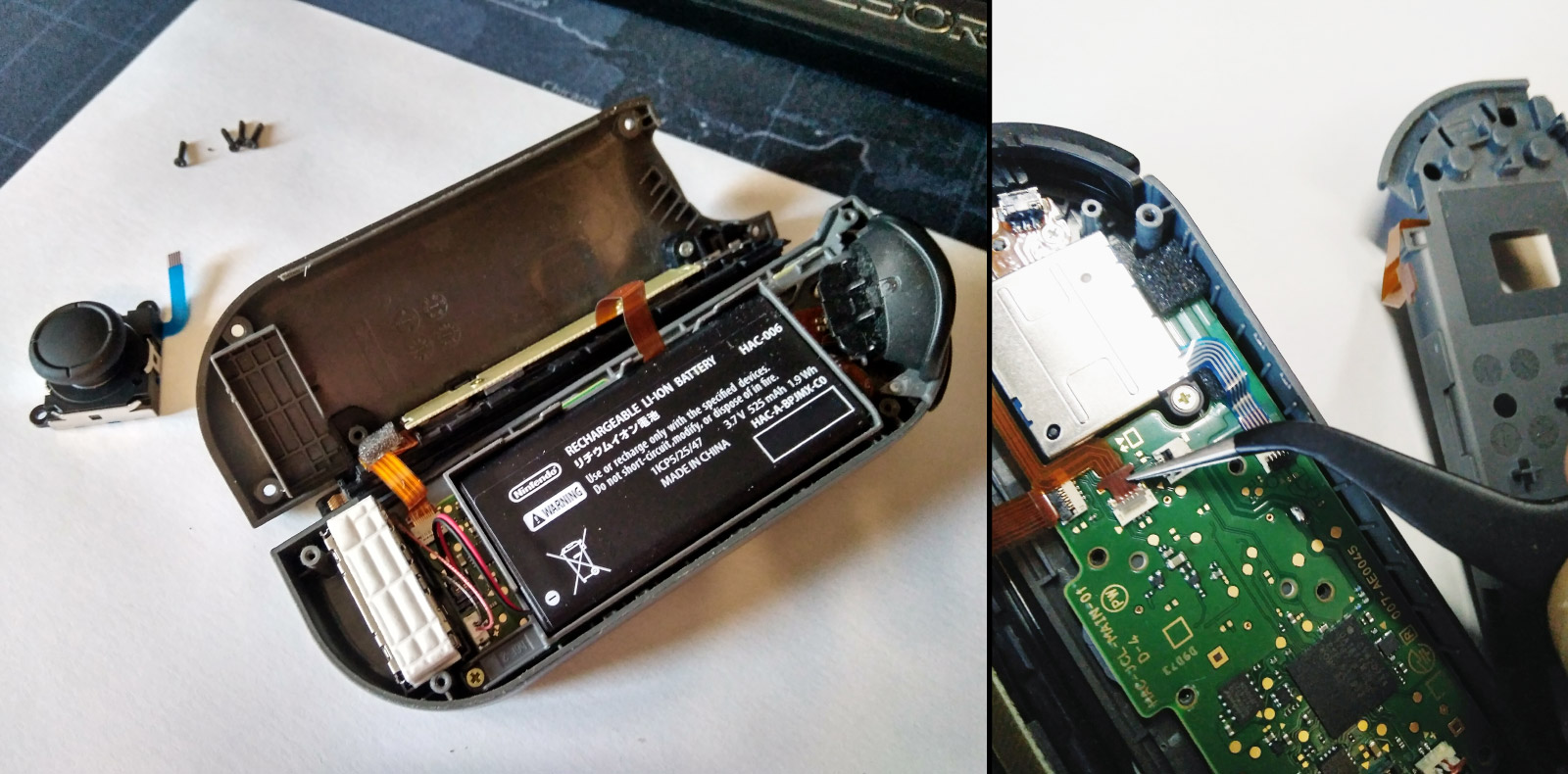
I will neither commend Nintendo for manufacturing a Joy-Con with an analog joystick that lasted for a whopping 200 hours, nor bash them for making it only last a meager 200 hours. Any component designed to move experiences wear and tear to a certain extent, so it's destined to fail sooner or later.
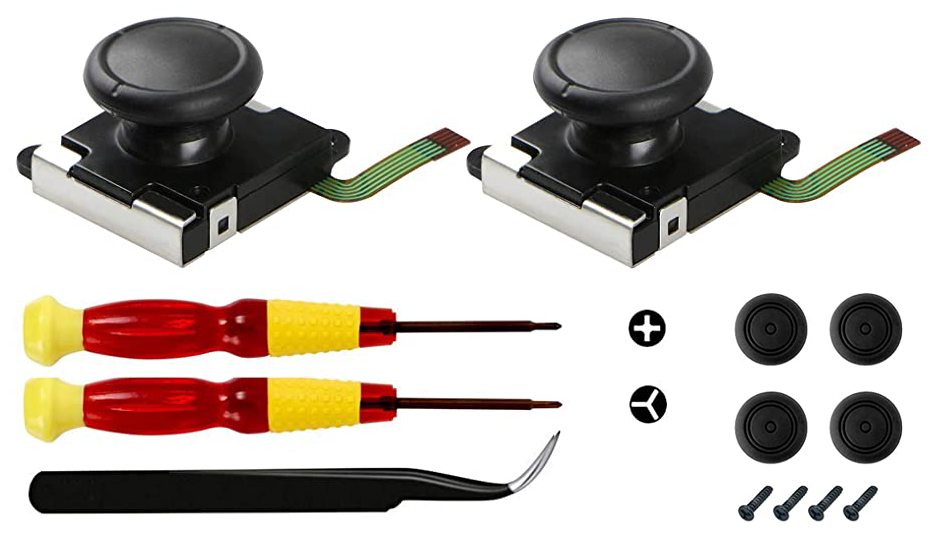
When it comes to Joy-Cons, even if you completely lack the tools, a couple of third-party replacement parts, tweezers and screwdrivers will set you back a mere fifteen bucks. And there's a plethora of video guides online explaining how to get the job done.
Finally, this fault has nothing to do with Ring Fit Adventure, but it's something I had to get off my chest.
As for the console itself...
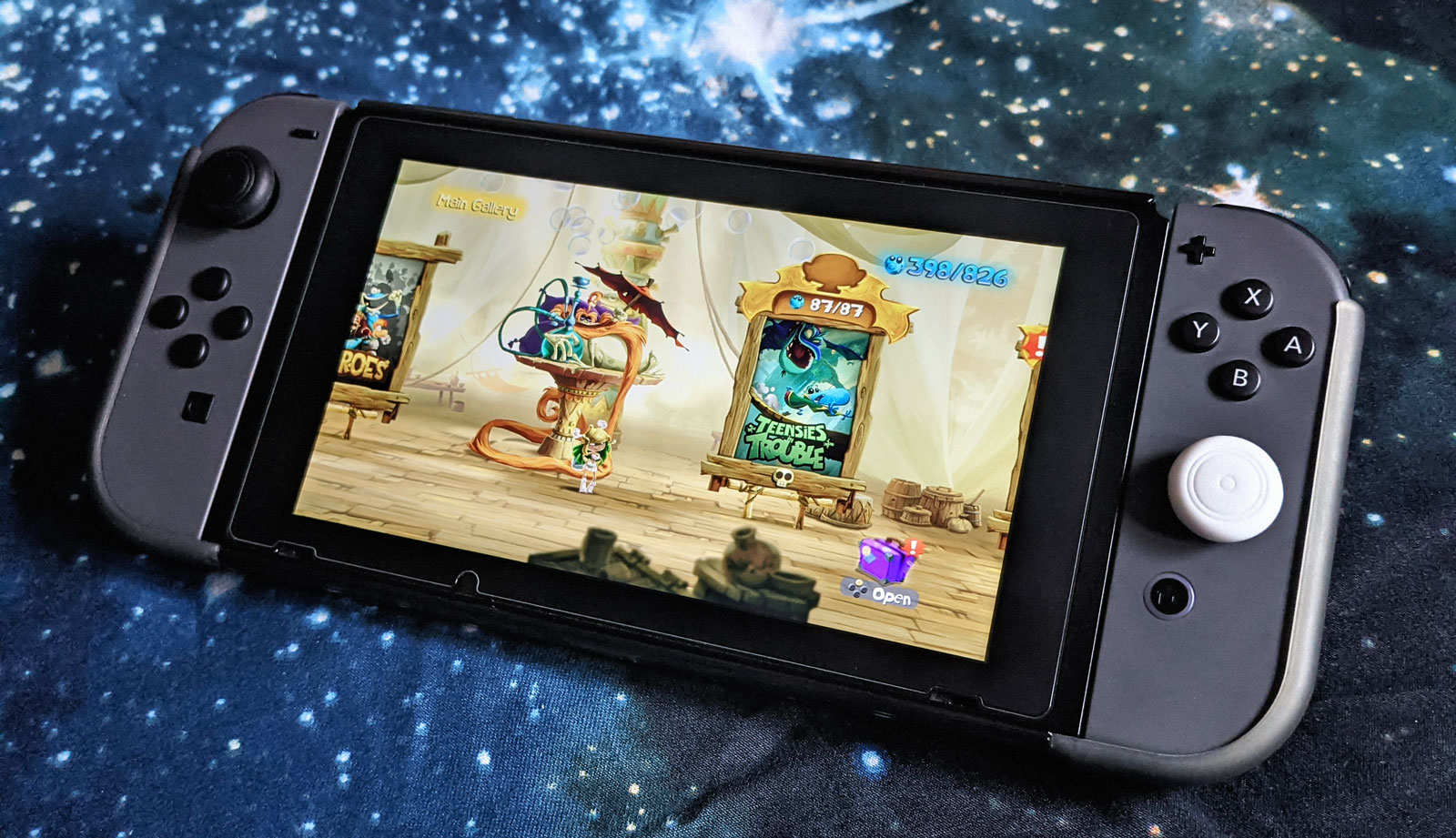
Oh, my. The console is a different story. Switch is built like a tank and designed to last. It's so well manufactured, solidly assembled and capable of keeping its thermals completely under control that I'm genuinely filled with delight every time I pick it up to play on the go. My unit has survived over 500 hours of use both handheld and docked and doesn't exhibit any signs of wear: it doesn't crash or g͜l̛i̡̛t̀͞͞c̴̵̀͞h̵́͠͞͝, the cooling fan is operational, the battery is in tip-top shape and the LCD panel and backlight are as good as new.
Even more impressive is the fact that my unit is from one of the first retail batches. It's not a newer 2019 HAC-001(-01) series model with an improved 16-nm FINFet X1 SoC. Oh, no! It's the OG HAC-001 produced in 2017. So not only is the console over 3 years old, it had to deal with a power-hungry 20-nm X1 SoC and the battery had only lost 10% of its capacity after all this time!
Truly impressive stuff.
The Software
There isn't much to write home about when it comes to the Switch's system software (a.k.a. Horizon OS). It provides an eShop, easy access to the game library and a bare minimum of save data management and peripheral connectivity utilities. Since the console lacks any meaningful productivity software or even the most basic internet browser, Nintendo Switch is just what it is — a game console.
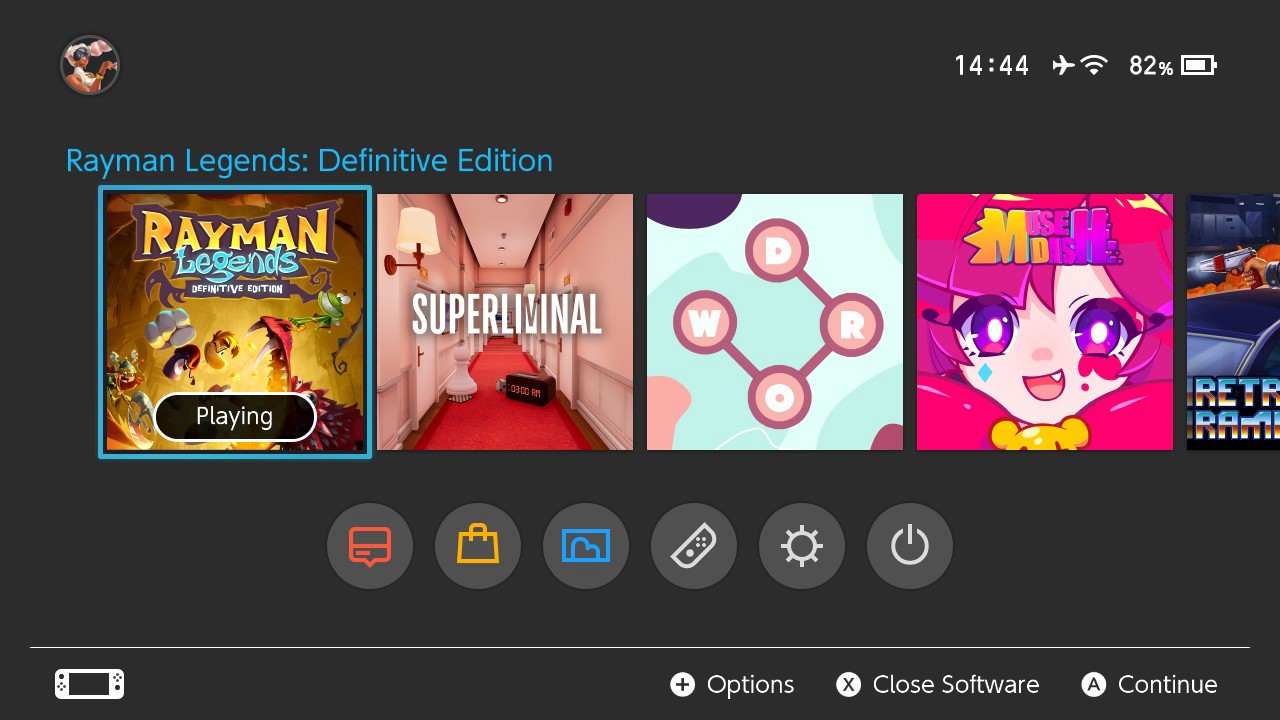
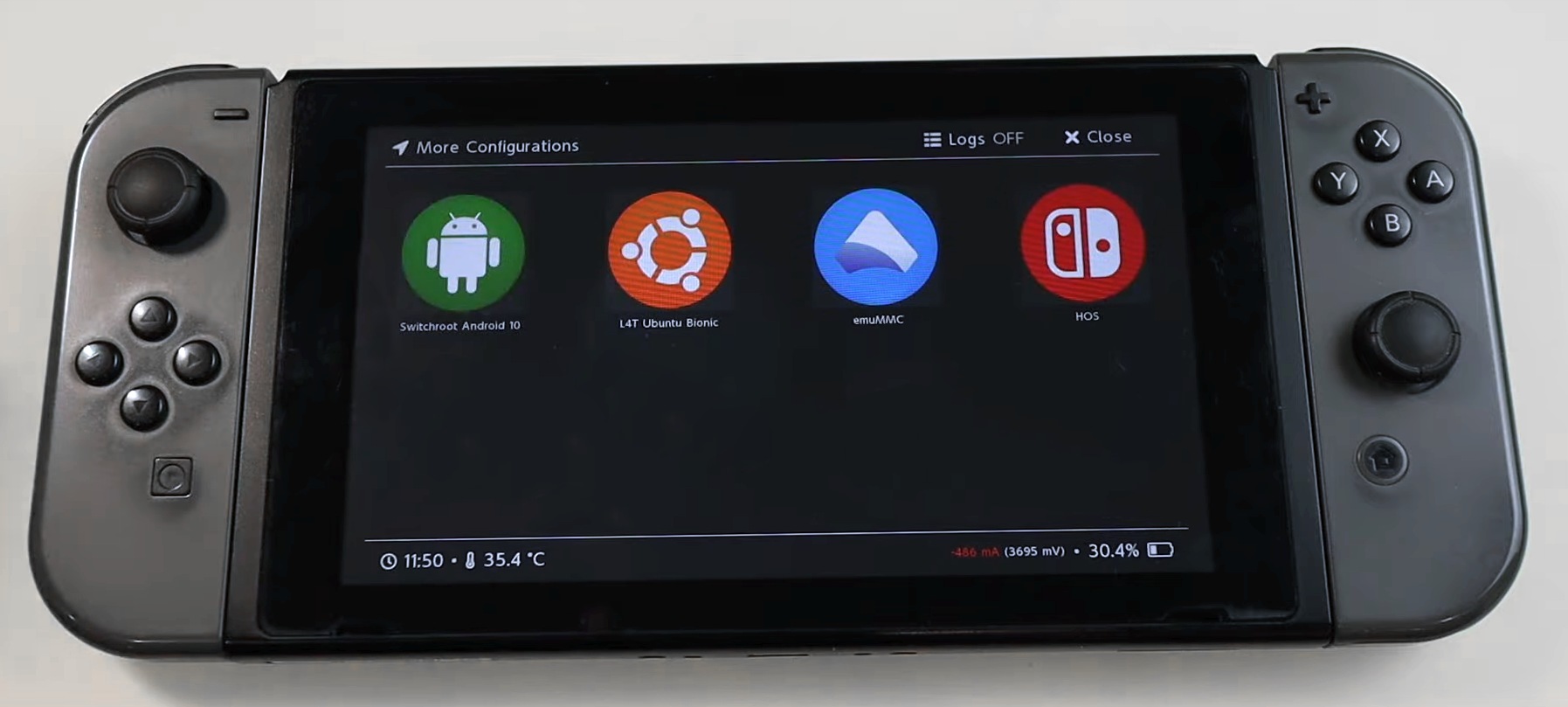
That is... unless you were lucky enough to get your hands on a "hackable" unit, which lets you do all kinds of cool stuff and even run Android or Linux on it. You can imagine what possibilities that opens up on such a powerful mobile platform. In fact, a portion of this post was typed using a Bluetooth keyboard paired with a Switch running Android 10, via a VNC viewer app connected to my PC over the internet.
So, yeah. Possibilities.
Still, limited or not, Switch is a very peculiar device. Even though I'm not much of a gamer nowadays, I do find myself leaning towards trying out new games on Switch rather than on PC or the PlayStation, simply due to it being a hybrid platform. Most of us could only dream of owning such a "transformer" of a console in our childhood. Being able to play on a TV or a projector and take it with you to a friend's place or school? Wicked cool, man!
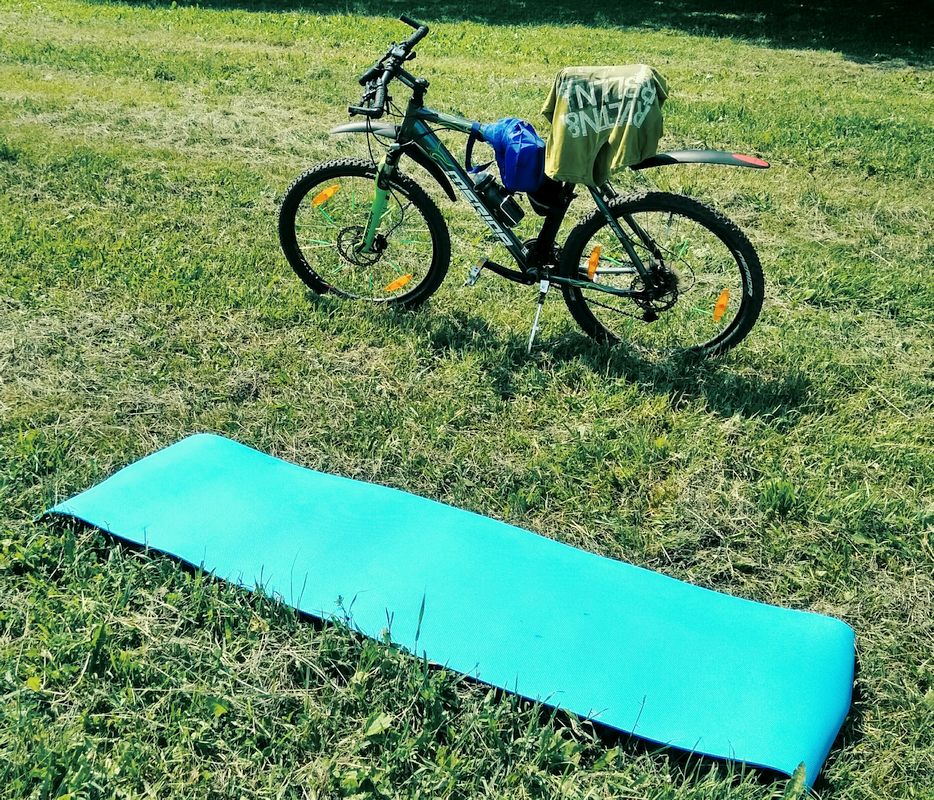
Last summer, on a hot and sunny day, I actually packed up my Switch, a yoga mat, the Ring Con and the leg strap and cycled to the nearby forest to... do a Ring Fit Adventure workout in a nice and quiet spot in the woods, surrounded by Mother Nature.
Am I an absolute dork for doing that? Oh, totally!
Did I enjoy the hell out of it? You better believe it!
Anyway, enough about the hardware — let's get to business!
The Good Stuff
I have so much to show and tell that I almost don't know where to begin!
The Story Mode
Believe it or not, to this day I still haven't completed the Story Mode (a.k.a. Single Player Campaign)!
It was a great way to ease me into the new fitness routine. And for a while it lasted — about 3-4 months — providing enough entertainment and incentive to keep coming back time and time again, until I discovered another game mode I'll cover in detail later in this post. So as not to repeat myself, I won't go deep into what the Story Mode looks and plays like, but if you're interested, check out the previous post.
In the meantime, I'll point out some features I found particularly noteworthy.
Changing Things Around
The game does a great job of diversifying the kinds of exercises it has you doing by varying the types of enemies you face (and the kinds of moves or attacks they're weak against) as well as the nature of challenges you can take up along the way.
One moment you are paddling up a waterfall in your makeshift kayak...
...to later find yourself battling the three fabled champions of the game world — each with their own special type of attack (and an exercise to match).
This variation in enemy and exercise types, regular introduction of new game mechanics, items, consumables, challenges and the like makes Ring Fit as addictive as it possibly can be — which, for a fitness game, is an outstanding achievement.
Non-Stop Progress
It's also quite satisfying to see the game track your progress and celebrate some of the outstanding milestones along the way:
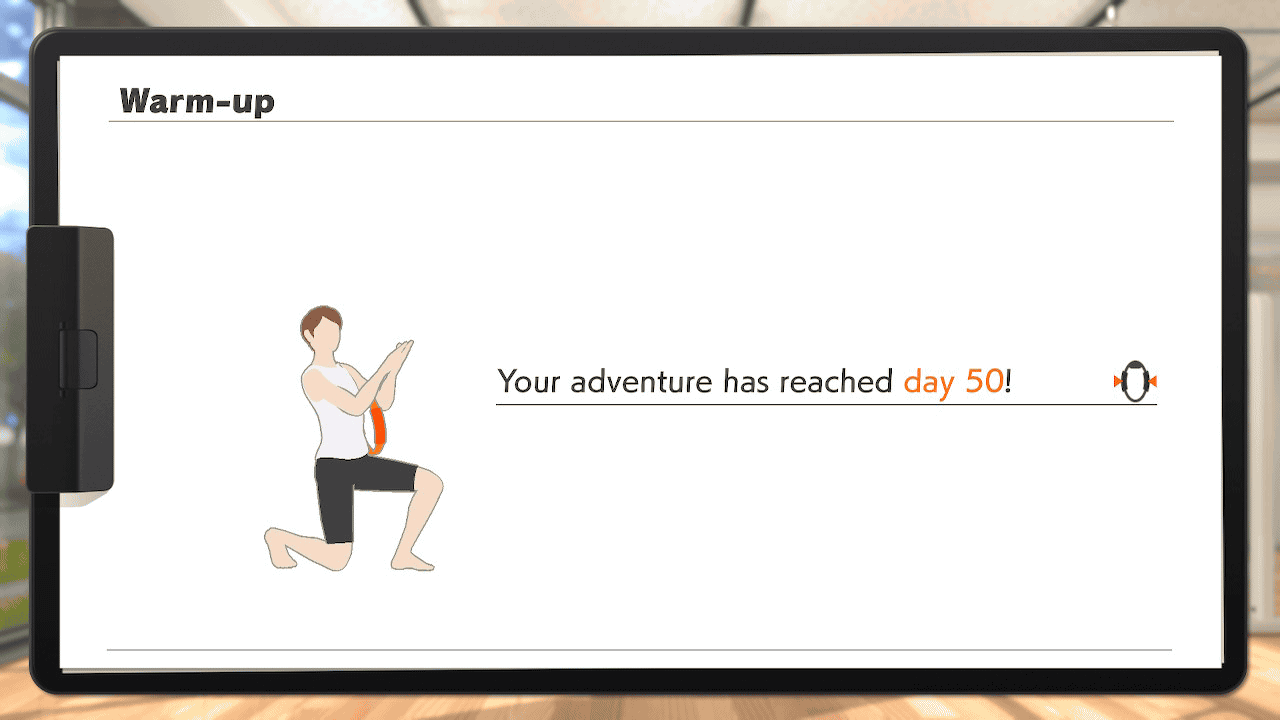
It exploits every trick in the book to make you want to come back:
- Did you do your first 100 sit-ups? — Have a round of applause
- Achieved 1000 mountain climber reps? — Watch Tipp jump around ecstatically
- Did you do some additional ring presses outside of the game? — Check those in and get some coin!
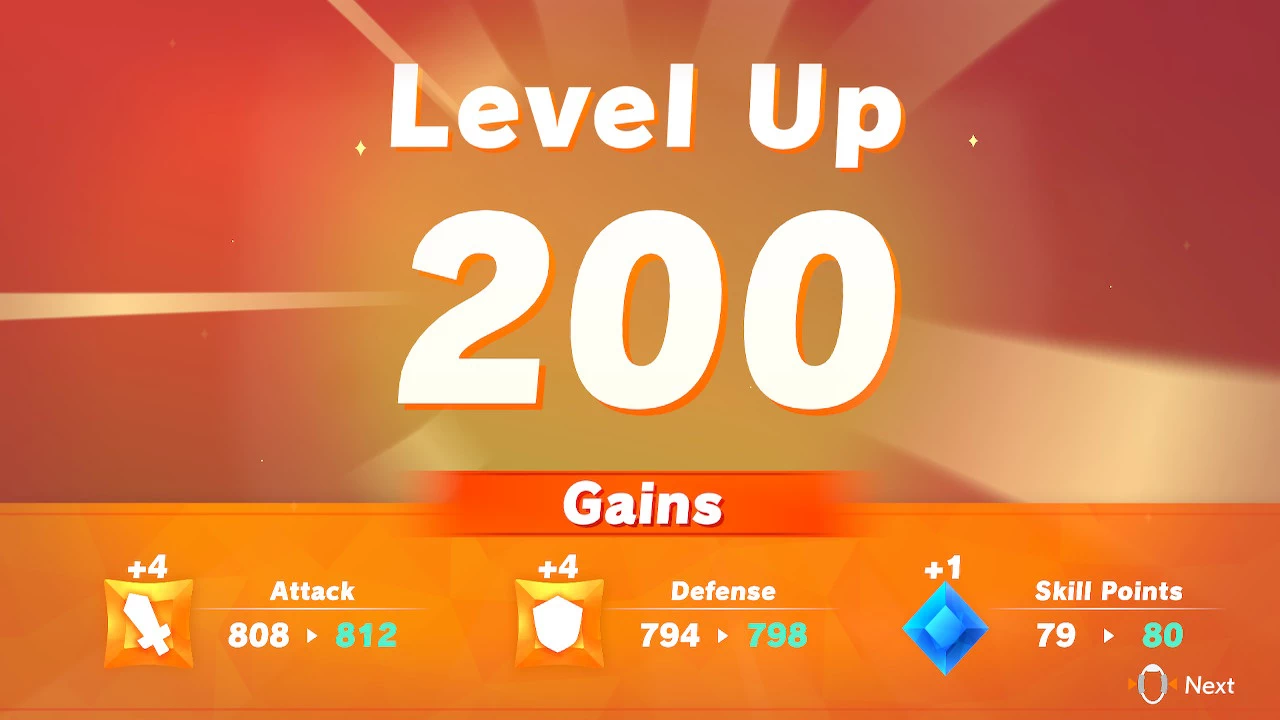
Don't even ask how great "leveling up" feels.
Every session begins and ends with quantifiable, visible progress: time spent exercising, calories burned, total distance "covered." This also adds to the overall feeling of achieving something after every workout.
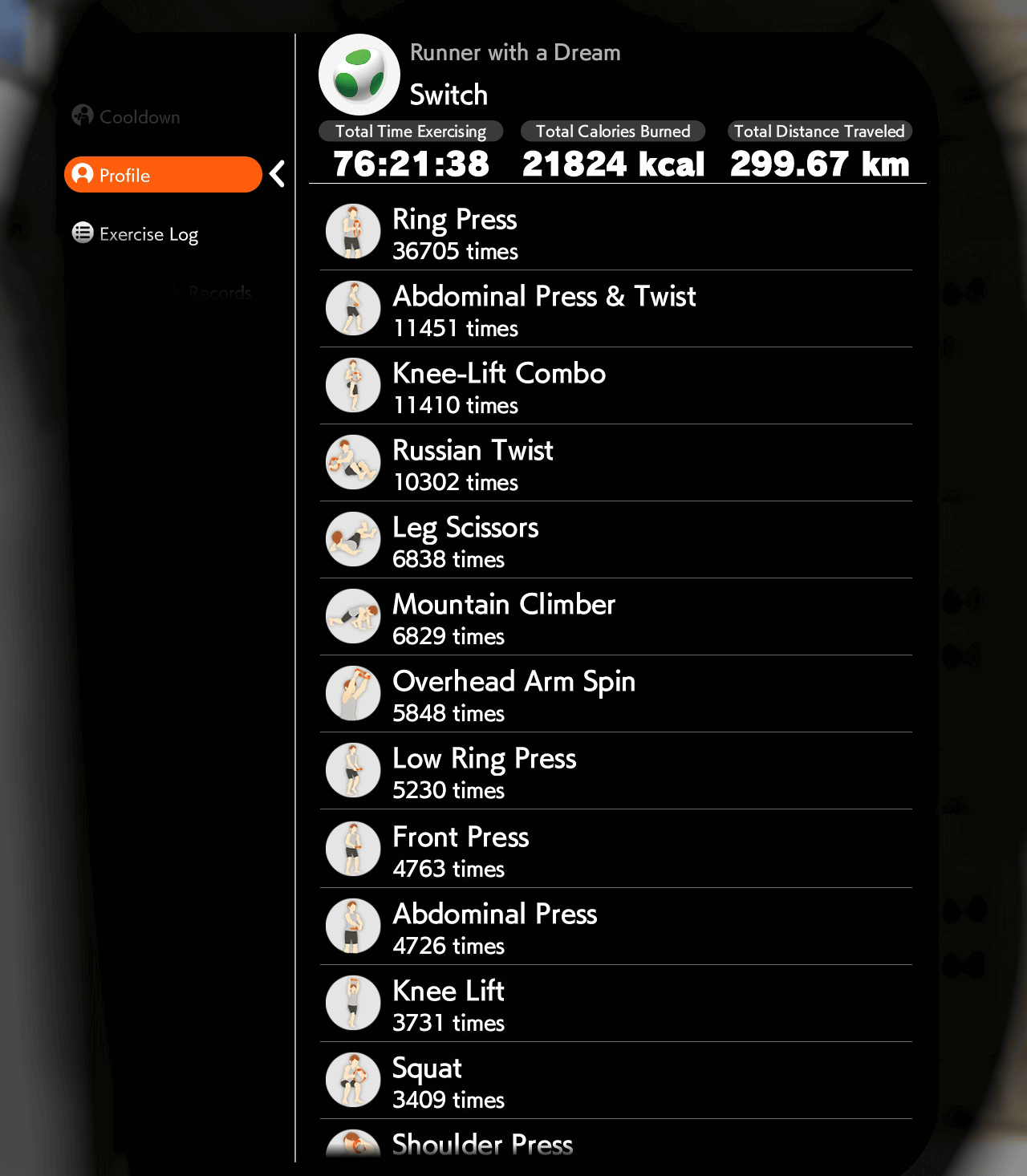
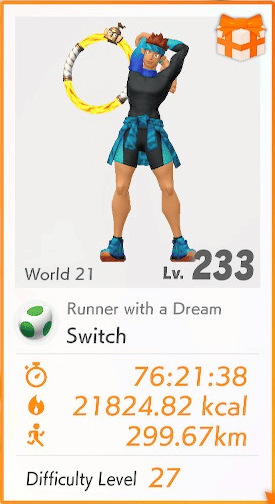
In the screenshot above you can see my total "activity timer." It only ticks when you're moving or striking a pose. If you're wondering how much total time was actually spent in the game, allow me to satisfy your curiosity:
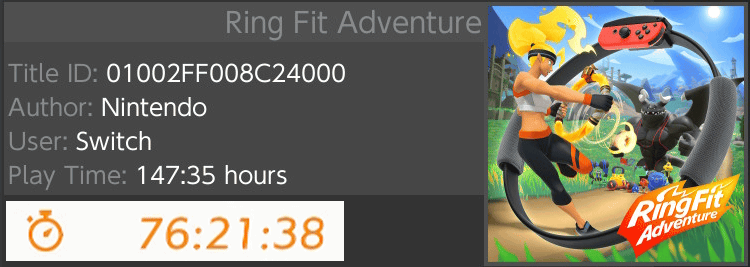
It's almost a 2:1 ratio, so about 50% of playtime was spent resting or fiddling around in the in-game shop.
While playing it's quite easy to get carried away and lose track of time — which is exactly how I managed to clock my longest session:
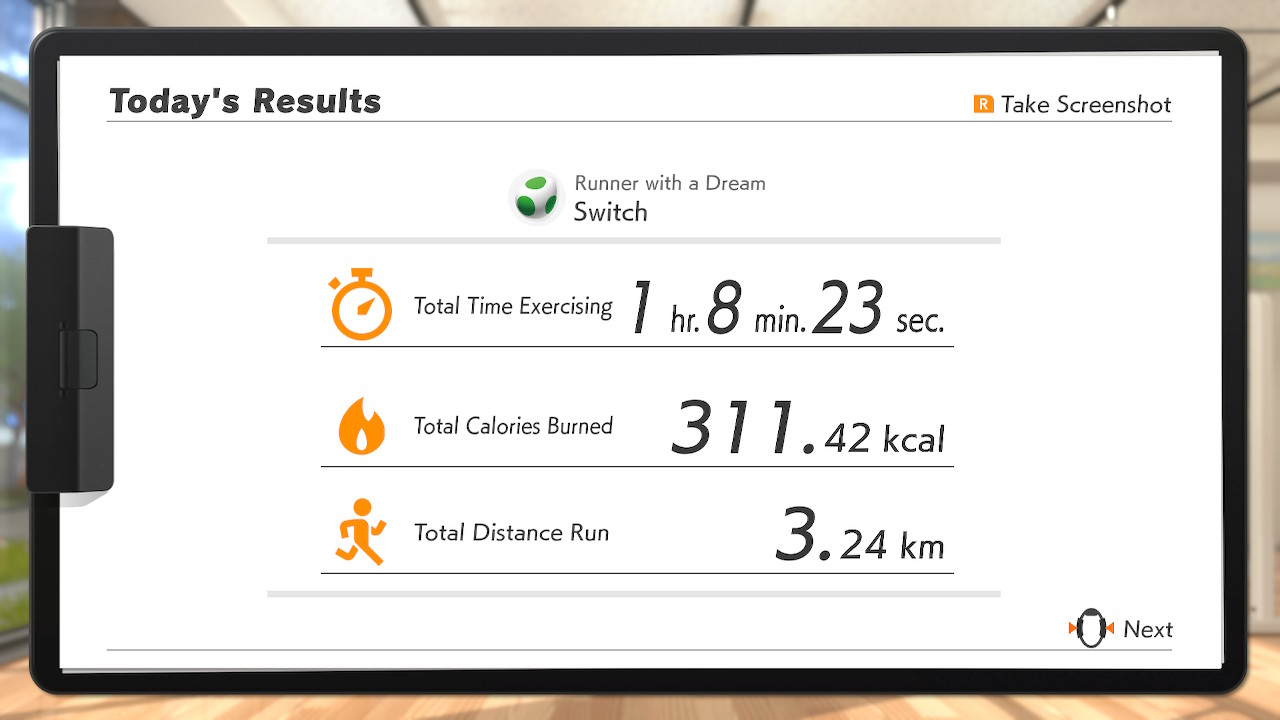
I wouldn't advise making a habit of working out for that long, though — I needed three full days to recover after one such session. Although your mileage may vary, naturally.
From the screenshot you can easily estimate how many calories you'd be able to burn from this type of exercise at a moderate pace — around 4.5-5 kcal per minute.
As Challenging as You Want It to Be
Finally, here's my experience climbing up the "difficulty ladder" in the game. After the first in-game estimate, I started at Difficulty Level 21. Since then I've gradually worked my way up to level 27, which I'm quite comfortable with.
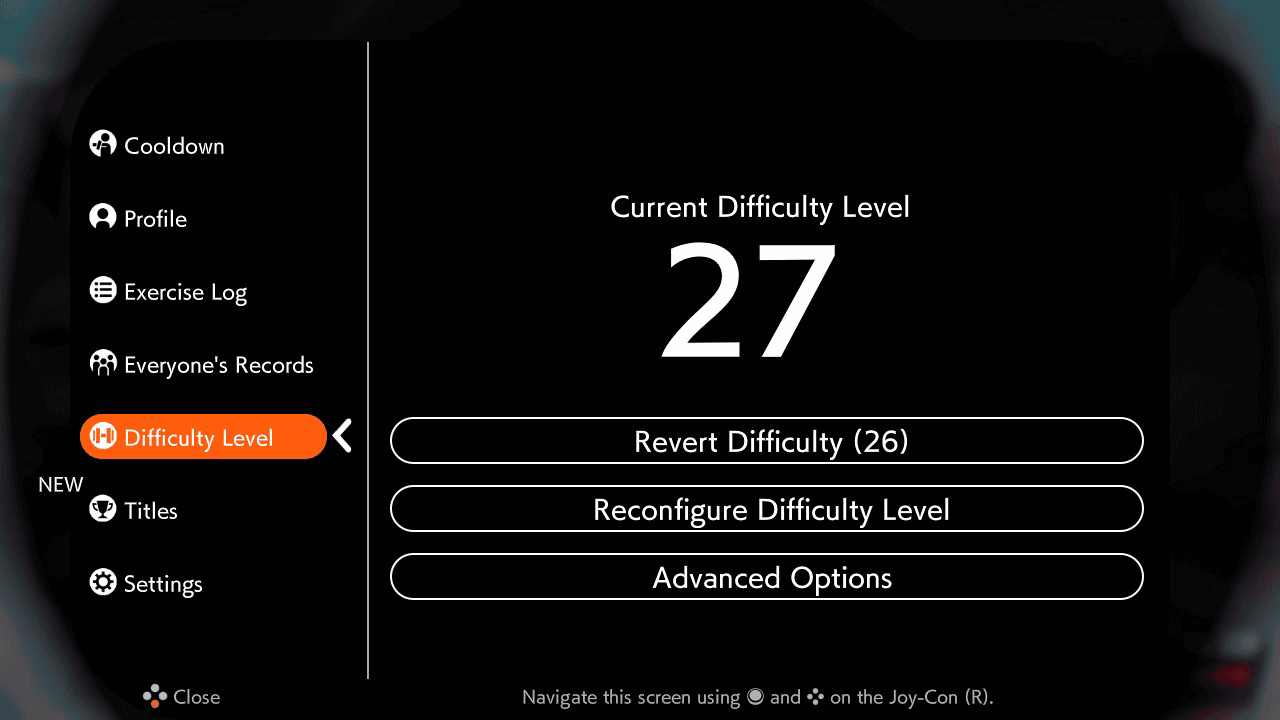
The Difficulty Level mostly affects the number of reps you need to do and fine-tunes how much health the enemies have in Story Mode. You can always dial the difficulty back without any penalty.
The Custom Mode
Like I mentioned before, the Story Mode kept me entertained until one day I decided to muck about in the game menus and discovered a Custom Mode, where you can build your own routines using all of the available movesets and activities: exercises, jogs, rhythm and mini-games. Since then it became my go-to mode for playing the game. So in my case it accounts for roughly 50% of total time spent in Ring Fit.

In fact, here's a short overview of some of my Custom Play Mode sessions. 49 of them, to be specific — recorded Oct 1 through Mar 14:
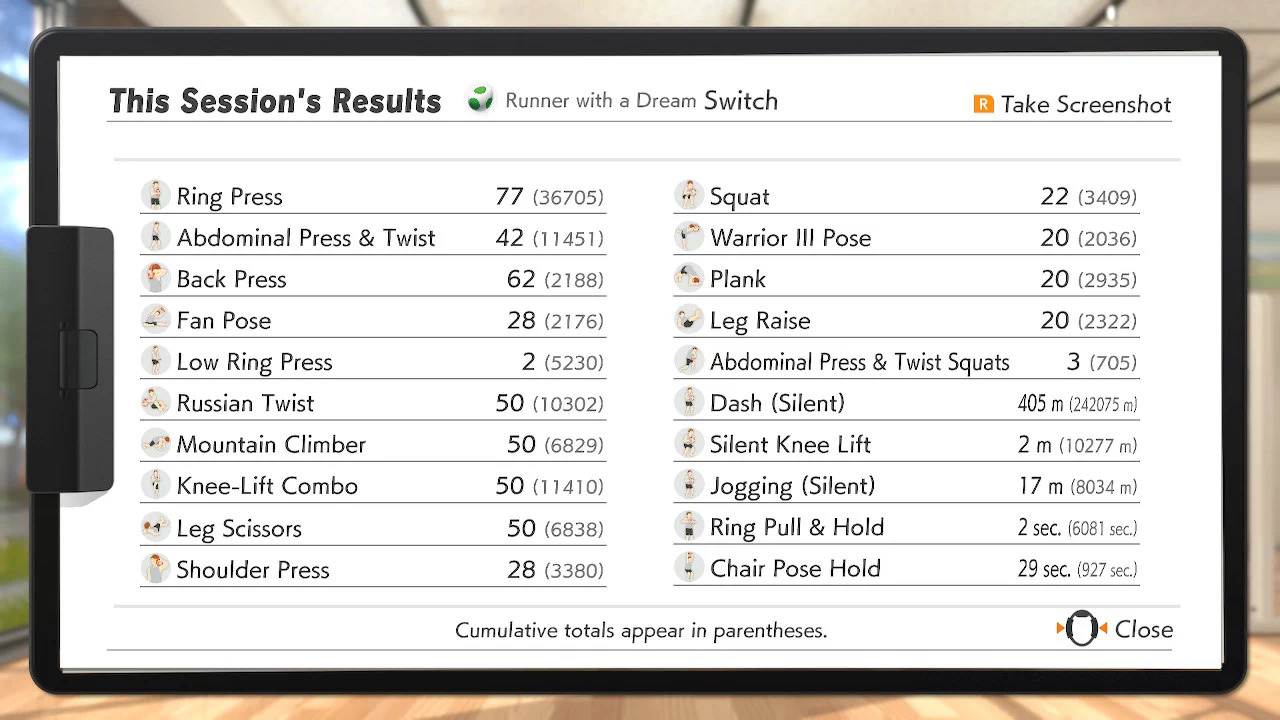
Each session is followed by the Session Results screen:
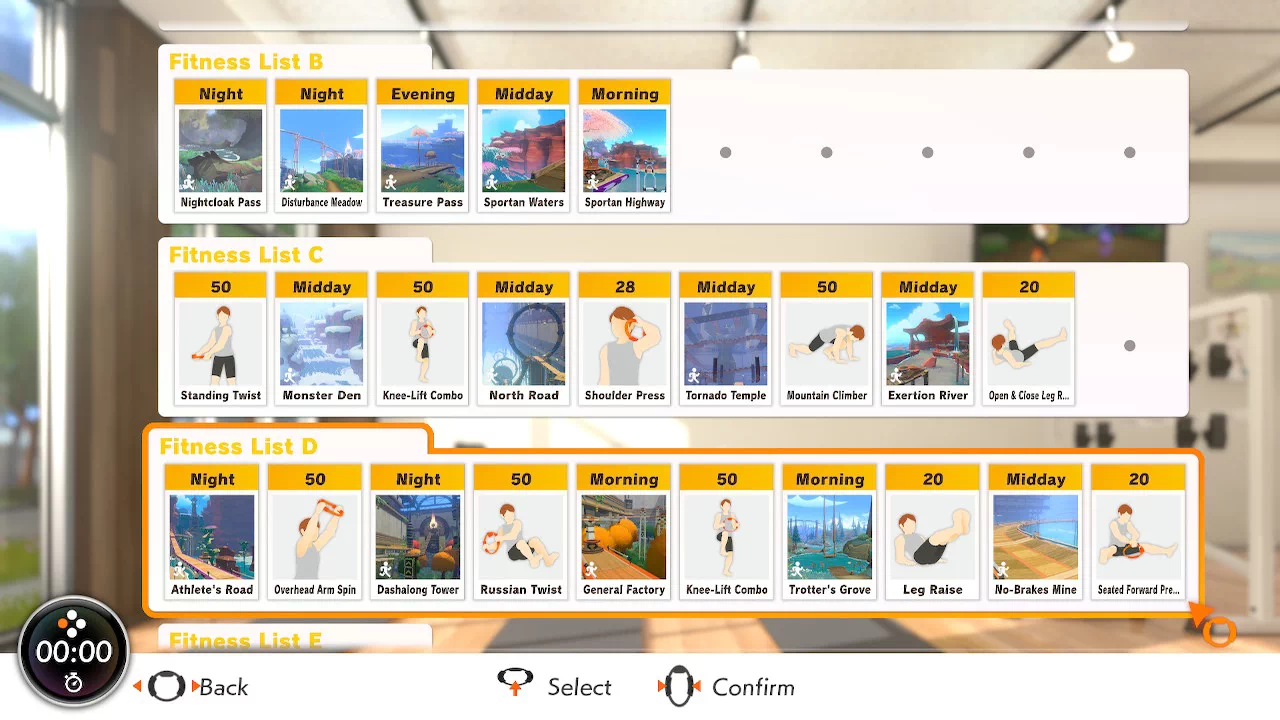
My Custom Workouts
Here's a small sample of some of my custom workout programs.
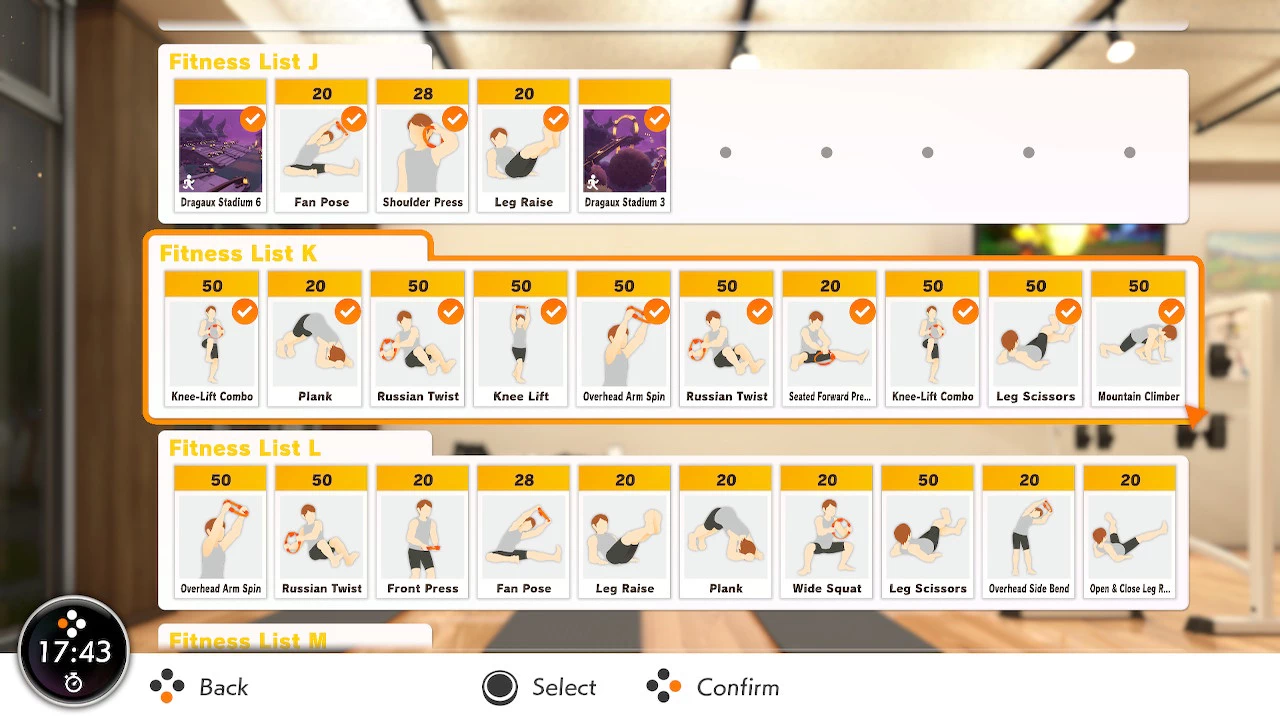
And a couple of intense ones, which I call "stamina sets," here labeled K and L and meant to be done in succession:
Workout Duration
For about six months I kept my sessions at the 30-minute mark, which meant running the same two Custom Fitness Lists every time. Eventually, though, I settled on shorter, more regularly spaced workouts of about 15 minutes each. This lighter schedule ended up being easier to stick to and less taxing on the joints — with results just as good. Or rather: as good as your diet allows, which is a topic for later in this post.
Quality of Life Improvements
At its core, Ring Fit Adventure is still just a fancy electronic exercise journal.
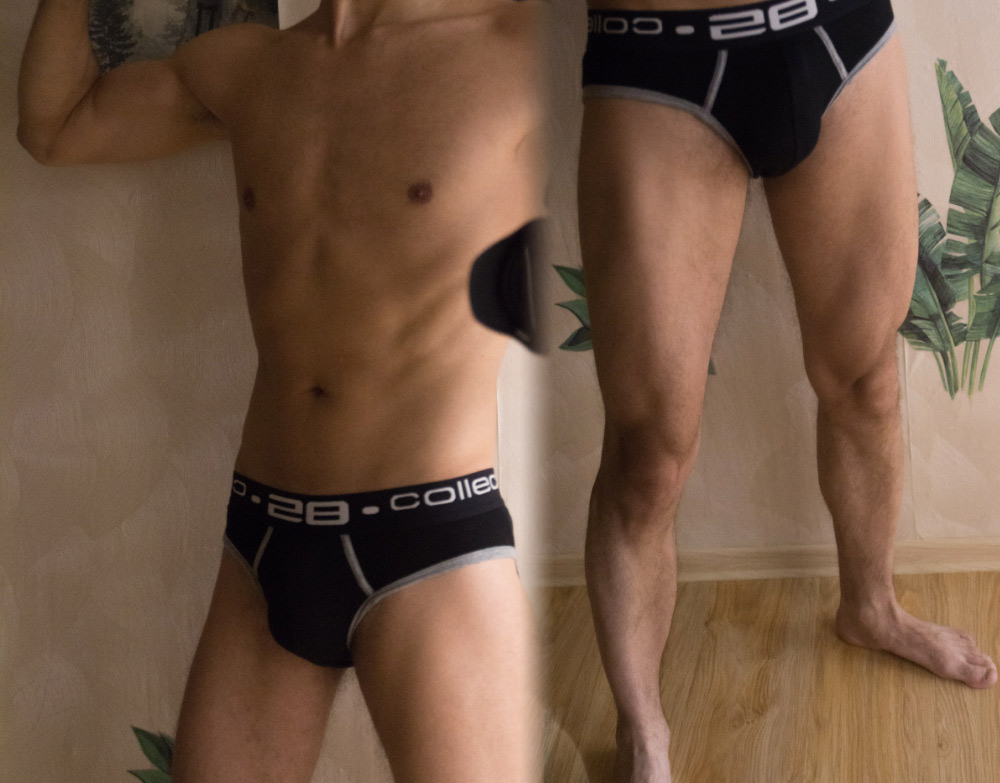
Therefore it makes sense that regular diverse workouts can help you maintain good shape. Here's how I look after a year of regular fitness and aerobic workouts — most of which were Ring Fit Adventure sessions. You'll especially notice the leg gains — which isn't coincidental, given my long history of ice skating and rollerblading. For me, it's much easier to build lower-body muscle mass than to bulk up the upper body. I won't post "before" photos because I never bothered taking them in the first place — Ring Fit took me by surprise, and by the time I decided to start logging my progress, I'd already changed too much for the photos to serve as any sort of "reference." Just picture a fair amount of that classic office-worker belly fat and love handles, and you'll get the idea.
So... Does It Work?
Would I say sticking to regular workouts with Ring Fit Adventure helps get in shape? Absolutely. But for me personally, Ring Fit was the missing piece of a "puzzle" called "How to motivate my ass to exercise regularly." And I couldn't praise Nintendo any more for coming up with such an original approach to workout gamification.
Just to sum up, here are some QoL improvements I actually noticed over a year of playing Ring Fit:
- No signs of carpal tunnel. You know, the cramps you sometimes get in your wrist when using a computer mouse for extended periods? Yeah, those. It used to be a rather regular occurrence for me, but ever since I started playing (remember the ring? — you hold it with your hands) I haven't had so much as a twinge while using a mouse, keyboard or any other peripheral
- Increased endurance. No more heavy breathing going up a flight of stairs or two
- Increased lung capacity. I can hold my breath for longer and recover quicker after sprinting and swimming intensely
- Reduced and more even heart rate. Sudden changes of intensity in everyday life don't bother me as much as before
- Less joint crackling. Don't know about you, but I was always prone to loud joint crackling after some time of inactivity. Maybe it's because of the accumulation of salt or something like that, but after getting back to regular exercises this issue has been largely mitigated
- And last, but not least — playing Ring Fit Adventure helped me establish a healthy diet as well. The game showers you with dieting advice and even one of the in-game mechanics revolves around making smoothies with various ingredients and recipes. And although the game takes place in a magical world, those recipes are real. And just looking at those colorful smoothies you "squeeze" in a mini-game made me want to try them out in real life. Which I did and discovered some new drinks and soups along the way
Injuries
Wouldn't be fair not to mention that as with any game where you play with yourself, there's a chance to get a trauma or a sprain. In my case the only two instances I remember were:
- While running a bit too recklessly, I kind of lost track of my movements and made a crooked step, spraining my ankle. It took a couple of weeks to recover and gradually return to previous levels of workout intensity. My bad, really
- When I first started playing the game, I was doing it barefoot, for I thought a yoga mat would be enough to cushion the shock of stomping my feet on the ground. Nope. After just a couple of workouts I realized that I had actually bruised my feet — such strong were the shocks when running in place during gameplay. So I got myself a pair of cheap running shoes and haven't had such an issue ever since
Tips and Tricks
If you decide to try the game out or do similar regular workouts, I've got some tips and tricks to share.
Before You Play
Exercise gear:
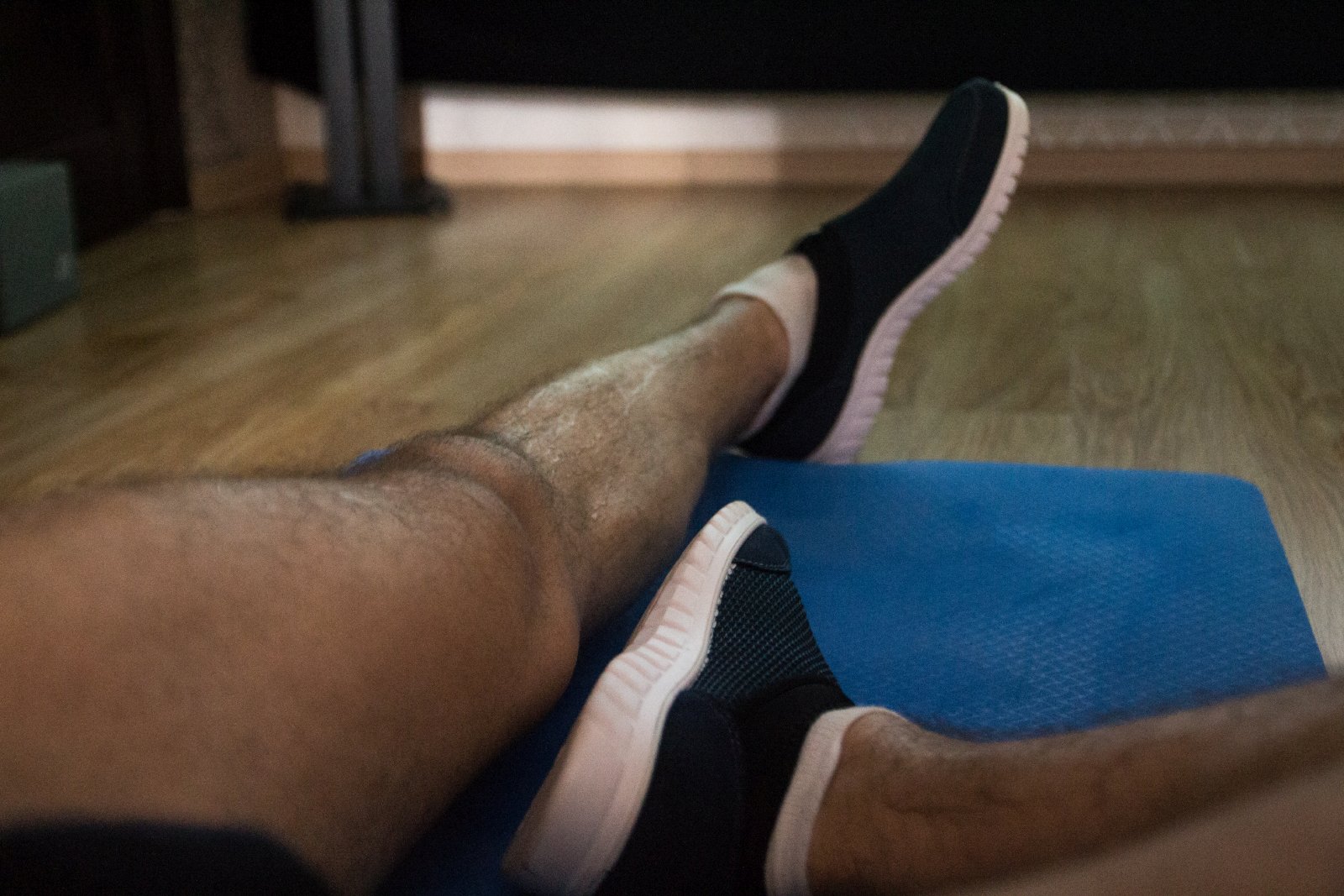
- Yoga mat. A good non-slipping mat is the perfect place to perform all those intense moves
- (Paper) towel. Depending on your weight and the intensity of the exercises, you will probably sweat quite a bit, so a couple of paper towels are a must. Yes, I do mean paper towels. I found they work best because they soak in sweat quickly and can be easily disposed of after a workout
- Running shoes
- A bottle of fresh water
- A large TV or a projector. It makes the whole experience even more fun, especially when the environments and the characters are "life-size," particularly when playing on a 120-inch projector screen
Before the Workout
- Warmup. A good warm-up is paramount! The built-in couple-minute warmups aren't enough to effectively prepare your body and muscles, so make sure to stretch and warm up for at least 10 minutes before you start
- Hydration. Try never to exercise when you feel dehydrated. Drink a fair amount of water and if you're dehydrated, wait for at least half an hour to let your body re-hydrate
Switch to "Silent" running. It's designed to replace track running and knee-lifts with quick, deep squats, but it works just fine even when you actually run. Sometimes you'll want less stress on your feet and ankles by squatting instead. Well, in Default mode that won't work very well because the game always expects a "running"-like motion. In Silent mode, though, the software has a harder time distinguishing what you're doing, so it accepts either approach — even if instead of deep squats you still do knee-lifts wherever appropriate on a track segment. Naturally, it will slightly affect the precision of calorie calculations, but it was always meant as an estimate in the first place, so I don't see it as an issue

Switch the Fit Battle setting to "Always complete the last exercise" or "Complete exercises that switch sides." It's a fairly new setting introduced with an update. Ideally you always want to train both muscle groups evenly, which is why this option is important and in my opinion should always be enabled

During the Workout
- Drink water! In a 30-minute session I usually end up drinking at least half a liter
- It's OK to stop and catch your breath. Something you should avoid during any fitness workout is running out of breath and trying to push through. Unless you're deliberately going for hardcore stamina training and know what you're doing, you'll simply end up overtraining, which requires longer recovery between sessions
- Alternate the Story Mode and the Custom Mode to mix it up and keep yourself motivated
- Watch your form when moving or striking a pose. Doing exercises with bad form might make them feel easier, but they're also less effective, can hurt your overall progress, or even cause injury. If you find it difficult to do certain exercises, try lowering the Difficulty setting or creating a Custom workout list with a focus on similar moves and poses to help you improve
- Try swapping in Planks with Push-Ups instead. They register pretty much identically on the Joy-Con strapped to your leg, so feel free to mix them up. Especially since the game doesn't have an "official" push-up moveset
- Don't skimp on stretch-type exercises. In Story Mode most stretches are used to recover your hearts. If, like me, you're almost always stocked up on smoothies and good at blocking enemy attacks, in most cases you won't need to recover hearts very often — which means less incentive to use them at all. This isn't ideal, so you might want to still do them between battles to mix things up or set up a custom workout list consisting mostly of stretches to go through from time to time
- Some exercises register imprecisely. Mountain Climbers are the worst offender. They register most movements at a tolerance of 80-100%, so the final score settles around 85-95% even if I do all moves perfectly. I've heard that for some players it can be worse, but don't let this demoralize you! Again, Ring Fit is about exercise, not online ladders and competition
- Try to maintain a moderate heart rate without suffocating and gasping for air. Keep your exercises as aerobic as possible — your body needs oxygen to burn fat
- Calibrate the Ring-Con at least once every 5-10 sessions to make sure it's properly tracking how far you're pressing and pulling
After the Workout
Update your weight in Settings from time to time. Regular workouts almost always lead to weight loss. The less weight you carry, the fewer calories you'll burn. So to keep that "Calories Burnt" estimate as close to reality as possible, make it a habit to weigh yourself every morning and update this setting accordingly every, let's say, 5 sessions

Between Workouts
- Take breaks between workouts and never exercise if you're not feeling well. That doesn't mean you should slack and look for excuses to avoid working out at all!
Develop and stick to a schedule. Patience and discipline! It takes time to get in shape, especially if you haven't been particularly active before

The game doesn't end after you complete the Story Mode! In fact, you can't complete this game. It's part of your life now. Embrace it
Dieting
Dieting is a complicated topic. And I'm no nutritionist. But what I do know is physics. And the Laws of thermodynamics. To lose body mass you need to consume fewer calories than you burn in a day. There's no way around it, no magic pill, no "secret technique." Don't take it from me — listen to what an actual physicist has to say:
Before getting back into regular workouts, I used to pretty much eat non-stop:
- Watching a movie? — Chips and popcorn!
- Coding? — Some nice hot tea or coffee with a fat chocolate muffin, naturally.
- Playing games? — Well, goodness me, I absolutely need to get me that sweet-sweet sugary drink to stay energized and aware!
In reality, a good diet makes a world of difference and every little meal adds up, ultimately forming both your eating habits and the contents of your gut. Unhealthy foods lead to gut problems due to imbalance of bacteria, hence the name "unhealthy." Just by changing my diet and with no additional modifications to my workout routine, I dropped from around 80 kilos to 76.5 with a healthy BMI of 22.1, age 34. There's nothing particularly special about the diet itself, but this is what helped me:
- At least 7 hours of sleep. Good sleep helps reduce cortisol levels, which is important if you're looking to burn fat and keep muscle tissue intact (or grow more).
- Eggs, red meat, poultry, leafy green vegetables. If you like your grains as well, make sure the ones you eat are of the lower glycemic index variety to minimize insulin spikes. In fact...
- Cutting down on carbohydrates and saying no to sugar in the form of sweet drinks and additives is paramount. Not only does sugar rot your teeth, it causes insulin spikes which over time lead to insulin resistance, increased fat production and eventually — an advanced stage of insulin resistance called diabetes. Even if you're not into sugar, keep in mind that lots of carbohydrates can cause all kinds of inflammation in the body. And once again — almost any amount of carbs will raise insulin levels. For your body, higher insulin literally means: "Don't burn existing fat! There's more energy coming from the outside" — which makes it tremendously hard to lose even a little weight without feeling lousy as hell when you cut back on calories
- Consuming 300-500 kcal less per day. This isn't something I'd call a sustainable strategy, but if practiced from time to time, it should help you lose some weight in a relatively short amount of time. The easiest way to do that is to just start splitting meals. First you take away 1/4 from your plate. Then 1/3 and eventually you'll start splitting your meals all the way in half. In my case, it took about four months to get used to the new eating habits. Yep. Just like the Universe itself, changes in our bodies take time — but those gradual changes stick for longer. Try using a calculator to estimate how many calories a day you might need and consider cutting down on that chow. Still, do realize that you can't cut down on calories forever. Use this as a way to "break a plateau" whenever you think you're not getting the results you need when it comes to weight loss. Long-term, it's much more beneficial to alter your dieting habits: better fuel equals better body
Eating less junk food. Hamburgers, Hot Pockets, chips, chocolate bars, pudding and the like are definitely inferior when compared to a good diet. For reference, 1 hour of fitness exercises will usually burn 150-250 kcal. Now stop for a moment and consider the following: one 100-gram slice of pizza contains around 300 calories (and most of them — carbs, which cause insulin spikes and contribute to visceral fat production). Now tell me: do you usually have just one slice or is it more like 2 or 3 when going out with friends or family or just ordering pizza delivery? Or maybe you sometimes chow down the whole damn thing... hmm?

And lastly, something I would've done if I were a drinker: say no to alcohol. Alcohol is a toxin. No matter how you look at it, it's not good for you. Never has been, and never will be. Not a single controlled study has concluded that even small amounts of alcohol are good for the body. It's all empty calories, some buzz and finally — a hangover.
100-Hour Milestone
I made it all the way to 100 hours on the activity timer and... eh, no big deal. This is just the beginning.

6-Year Follow-Up Available!
⭐⭐⭐ Don't miss the follow-up post: 6 Years Of Fitness With Ring Fit Adventure. Results, Custom Workouts, Notes On Sustainable Wellness. And a Survey! ⭐⭐⭐
Wrap-Up
Phew. Well done getting all the way to the end! Shows how dedicated you are to improving your well-being.
Now it's time to take it to the next level and actually begin working out. Whether you choose to go with something like Ring Fit Adventure, come up with your own exercise routine, or better yet — ask a professional to help you with an exercise program — I hope it... works out (yes, I truly am a comedy genius). So ultimately you end up having a good time and getting in shape on the journey to better fitness.
And remember: there's no "endgame" to fitness — it's something you make a part of your life.
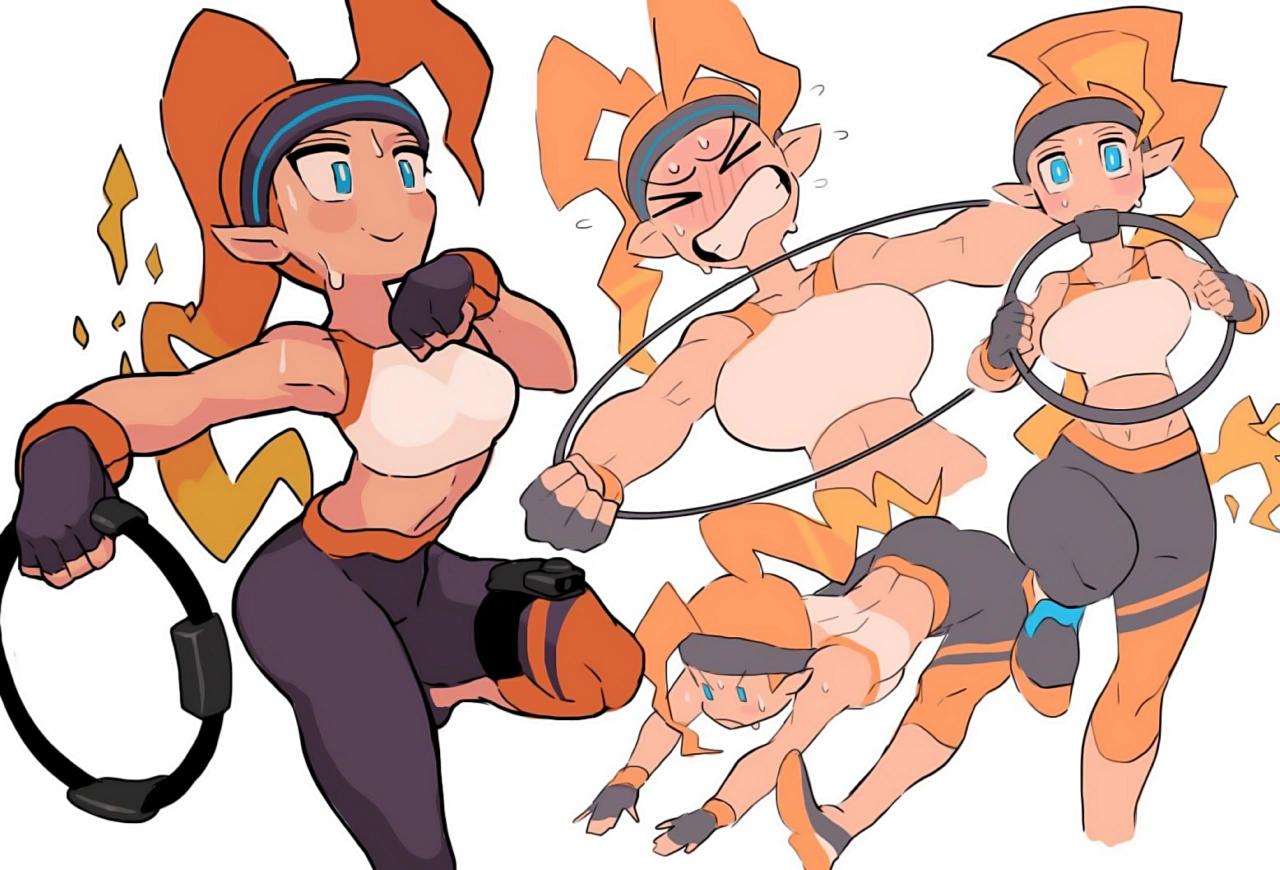 Ring Fit Adventure Girl by Gashi-gashi